This week’s creation was a French (though I think it is French-inspired, not an actual French recipe) Apple Cake. It seems the French part is that it is a soft custardy cake rather than the more solid, crumbly American-style cake. Regardless, it started with discounted apples at Thrifty Food. 5 slightly bruised organic apples for $2 had dessert potential written all over it. Now my immediate thought was apple crisp. For the record, I make the most incredible apple crisp, if I do say so myself. My apple crisp recipe is peer reviewed as being absolutely spectacular. The key is extra crisp topping and my secret ingredients: lemon zest and juice. I use a full lemon worth of juice and zest in the apple filling, and it is delicious. But we are expanding our horizons and not going for the tried and true, so I explored Pinterest for our next experiment.
I settled on French Apple Cake because I have never baked with thinly sliced apples nor made a custardy cake. The recipe had the right level of newness for my purposes.
The Process
For starters, I forgot to peel the apples. But this is fine, because peeling apples is stupid. Here is a tangent for a controversial baking opinion: peeling apples in recipes is silly because the skin is quite palatable and apples get so soft once baked that the skin become virtually indiscernible from the rest of the apple. Why waste time and nutrients?
Anyway! The cake! Slicing the apples thinly is a task usually performed using a mandolin, but I A. do not have a mandolin and B. probably should not be trusted with one because I am notorious for injuring myself in the kitchen and even terribly cautious chefs have sliced their fingertips off using these things. I was impressed how thin the slices became after I got some practice at it!
I followed the recipe with a few changes. I omitted the almond extract and used extra vanilla extract to compensate (vanilla is measured with my heart, not teaspoons). I omitted the apricot preserves because I did not have any, but added brown sugar to the almond-apple topping in hopes it would caramelize.
The Recipe:
https://www.littlespicejar.com/french-apple-cake
Making a French Apple Cake
- Prep things first. Start by placing the oven rack in the center of the oven and preheat it to 350ºF. Grab a springform pan and line the bottom of the pan with parchment paper. This will help the cake release easier from the cake pan makings much more simpler to serve.
- Slice the apples. Peel the apples using an apple peeler or a regular vegetable peeler. Grab your mandolin and thinly slice the apples to create razor thin slices. This will take some time so I like to add a packet of lime to a bowl of cold water and let the apple soak while I prep the rest of the ingredients, this is totally optional though.
- Make the batter. In a large bowl, start by whisking the eggs and the sugar together on low speed if you’re using an handheld mixer or a stand mixer, I usually just use a whisk and rubber spatula! No need to dirty extra dishes with this one. Once combined add the almond extract, vanilla, and butter and continue to whisk. Then season with cinnamon, kosher salt, and baking powder. Finally you’ll add the milk and the flour. Fold in the apple slices. This will create a custard-like batter.
- Make the topping. In a small bowl combine the ½ cup of apple slices, that have been drained from the water. Add 2 tablespoons of sugar and the almonds. Toss and set aside for now.
- Layer the cake. Place the cake batter in the prepared pan, and smooth the top out to create an even layer. Then layer the topping apple slices over the cake and sprinkle the almonds on top.
- Bake the cake. Until golden and brown on top and it rises to almost double the height. I usually skip the toothpick checking with this one as it’s a little hard to check if it’s done.
- Brush with preserves. This is a secret little trick to get your baked goods to look extra special. Melt with water and brush on top. Let the cake cool for at least 30 minutes before attempting to slice. It’s easiest to slice once it’s cooled to room temperature.
Ingrediants
- 4 Granny Smith or Honey crisp apples
- 2 large eggs, room temp
- ⅔ cup granulated sugar (plus 2 tbsp)
- 2 teaspoon vanilla bean paste (or extract)
- ⅛ teaspoon almond extract
- ½ cup salted butter, melted
- ½ teaspoon cinnamon (optional)
- ¼ teaspoon kosher salt
- 2 teaspoon baking powder
- ½ cup milk
- 1 cup all purpose flour
- ¼ cup raw sliced almonds
- 2 tablespoon apricot preserves, for brushing
The Final Product:
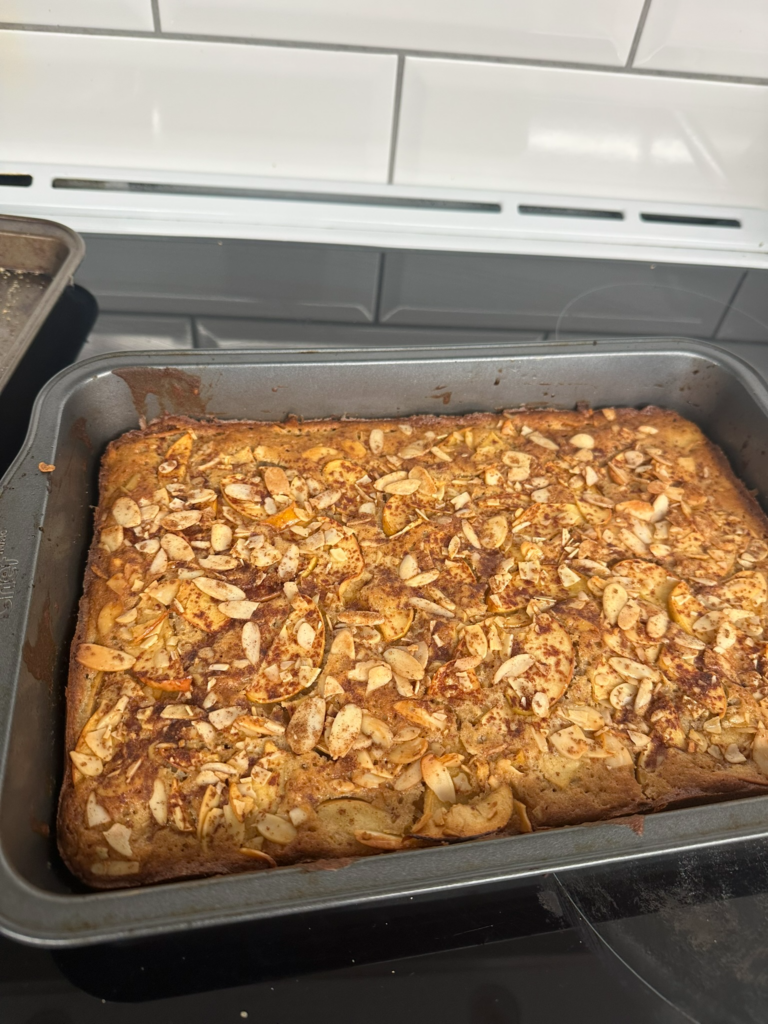
My review is that it was good, but not great. Its a “It’s quite tasty, but nobody is going to ask for the recipe” kind of deal. Good as a treat at brunch, not dessert at your dinner party. Perhaps apple crisp has ruined me for apple desserts. I will certainly eat it, however, and it was neat to do a flavor profile dependent on apple, vanilla, and almond, compared to my usual apple, cinnamon, lemon, nutmeg flavor profile.
I have found that trying new recipes seems less daunting when there are less people around. With everyone home for reading break, our dorm kitchen only has me and a couple stragglers frequenting it this week. I think I feel that way because the lack of audience means that if I fail at a dessert, nobody really needs to know, and I cannot feel judged on my skill. That’s something we are working on, because it frankly reflects insecurity that isn’t founded in reality. Logically, I know nobody cares if I mess up a single recipe nor thinks less of my skill. I imagine that the more new recipes I try, the less that will bother me. I want my next recipe to be more challenging technique-wise, that way I either have to do a really good job at a hard recipe or I fail and can sit in my discomfort with that.
Relations to Education
With my reflections on this recipe, I feel somewhat hypocritical. How can I as an educator encourage my students that failure is how we grow, if I do not also work on growing through failure?
On another note, I want to look more at how to integrate baking into the class, which is not something I had much opportunity to do in my K-12 education, but has increased in prevalence since then. I found some interesting resources online regarding lesson plans that include baking with the kids and have linked them below. I am considering writing my own lesson plan for baking with students (could relate to social studies using a recipe from another culture or to math using fractions?) or creating a child appropriate instructional baking video that could be used in the classroom or by parents.
Interesting Links:
https://sallysbakingaddiction.com/kid-friendly-baking-recipes
bcdairy.ca/lesson-plans/
Sorry, but comments are not enabled on this site.